
Sarah Ford
What it’s Like to Work in Mississippi’s Only Abortion Clinic
By Sarah Kliff
There are three doctors who terminate pregnancies at Mississippi’s only abortion clinic, a bright pink building in Jackson. Two keep their identities private: legal documents only refer to them as “Drs. Roe and Doe.” This anonymity is not atypical for abortion providers, who often face harassment and threats of violence. Eight abortion providers have been murdered in the past two decades, and another 17 have been victims of attempted murders. The third doctor who provides abortions in Mississippi is Willie Parker.
“I’ve not been unwilling to make it known that I’ve delivered babies,” Parker told me last week, as he drove through the backroads of Alabama. “And I’m not unwilling to make it known that I perform abortions.”
Parker is a rarity — not only because he provides abortions in the Deep South, but because he is so public about his work. He was recently the subject of a lengthy Esquire magazine profile titled, “The abortion ministry of Dr. Willie Parker.” He has conducted dozens of interviews, which he said he sees as a form of advocacy.
For years, Parker worked in urban areas of the country, places like Chicago and Washington, DC, providing abortions in areas of the country where the practice was largely uncontroversial. But last month, he moved back to his home state of Alabama with the express purpose of providing abortions in hostile territory — and leading the fight to keep Mississippi’s one clinic, the Jackson Women’s Health Organization, open.
“It was … a conscious decision to make myself more available to provide care in the region where access has been greatly limited by the political climate,” Parker said. “It became important to me to make sure these services are available in the region of the county where I come from.”
“Abortion access has changed dramatically”
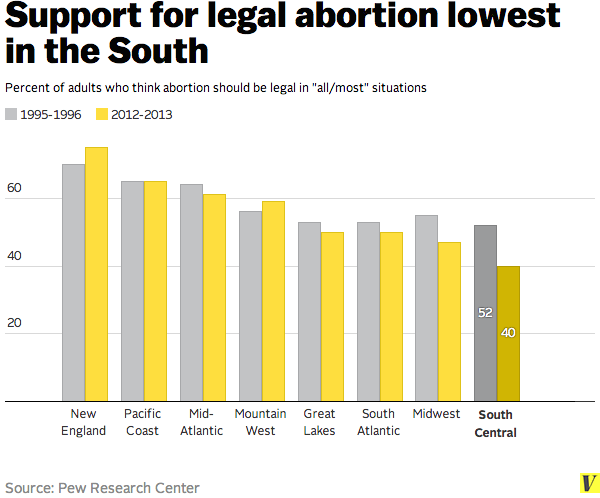
The South has become increasingly anti-abortion. In 1995 and 1996, the Pew Research Center surveyed each region of the country on their support for legal abortion in all or most situations.
The area that Pew calls the South Central region includes Alabama, Kentucky, Louisiana, Mississippi, Tennessee, and Texas. In the mid-1990s, a very slight majority — 52 percent — of those living in the South Central region said they supported legal abortion in all or most situations.
But by 2012, the next time Pew repeated its survey, that number had…
Get Resources and Insights Straight To Your Inbox
Explore More Articles
Corporate Volunteering: The Business Case for an Employee Volunteer Program
Corporate volunteering has evolved well beyond the occasional company service day. A well-designed employee volunteer program can strengthen employee engagement, reinforce company culture, develop leadership skills,…

Environmental Awareness Month
Every September, environmental organizations around the Nation come together in recognition of Environmental Awareness Month, with a goal to raise awareness about environmental issues that…
Join Feeding America and Take Action During Hunger Action Month
No one should have to go hungry in the richest country in the world — yet millions of Americans don’t have enough to eat. Our…
Get Resources and Insights Straight To Your Inbox
Receive our monthly/bi-monthly newsletter filled with information about causes, nonprofit impact, and topics important for corporate social responsibility and employee engagement professionals, including disaster response, workplace giving, matching gifts, employee assistance funds, volunteering, scholarship award program management, grantmaking, and other philanthropic initiatives.